Neko Duelist
As a cat stalks a mouse, Fighters who practice the neko duelist tradition bide their time until the perfect moment to pounce upon a foe with drawn steel. These Fighters weave through battle, engaging multiple enemies at once, ready to dart out at any moment to deliver a staggering blow through their signature pounce technique. The neko duelist tradition is secretive, and it may trace its origins to antiquity—possibly even early in the Age of Humanity.
What separates the neko duelist approach to combat from other fighting traditions is that most of its practitioners are cats. From time to time, a master of the style will agree to take on a bipedal student. Such Fighters are immersed in cat culture and taught the ways of the feline blade—above all, the art of the pounce. Though it may appear to others that these Fighters take on cat-like attributes, this is strictly a matter of technique.
There’s an unspoken rule that those who wish to become master duelists must be instructed in the tradition by an awakened cat. To attempt to pry knowledge of the style from a non-cat teacher is to incur the enmity of cats.

Building the Basics
As a non-cat neko duelist, it often takes years to be taught even the most basic skills and attributes of the cat. Students spend countless hours with their masters honing their timing, strengthening their bodies, and sharpening their perception. It's commonly said that, as a bipedal disciple, one must reimagine who they are and allow the qualities of the cat to become part of their nature before ever being instructed to pick up a blade.
A cat's supernatural senses are also not beyond teaching. Master Togi Obata, a legendary neko duelist, described cats' innate sixth sense as "a coin hidden within a riverbed." Some beings have a naturally shallow river, making their coin easy to find, while others have deep rushing waters, where the coin's existence is beyond comprehension. If cats have calm, shallow streams, then beings such as humans have dangerous rapids. That does not mean it is impossible to find the coin; it simply takes dedication.
The Pouncing Fighting Style is a feat option only made available to the Neko Duelist Fighter. Pouncing Fighting Style Feat
Celebrity
Becoming a neko duelist is a feat worth honoring in cat culture. There's a level of mysticism that surrounds the role, and their combat prowess is seen as beyond the natural. For non-cat duelists, there is an added degree of dedication and hardship that must be endured, which warrants a certain amount of respect. As a result, a duelist, cat or not, is treated with admiration in most instances and as a celebrity in others.
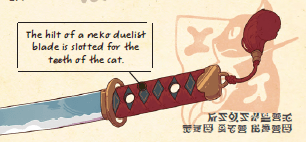
The Feline Blade
The blade of a cat is unlike any weapon crafted on Obojima,
and though its form is familiar, the subtle details push the
duelist’s blade into a category of its own. These tools are so
perfectly fitted to the cat's body that many non-cat neko
duelists choose to abandon the blade type altogether for
something more familiar.

Level 3: Cat Whisperer
You can comprehend and verbally communicate with felines. You can use any of the Influence action’s skill options with them, and you have Advantage on any checks you make against them as part of that action.
Level 3: Feline Nature
Your training alongside your master has earned you the attributes of the cat. You gain the following benefits.
Catlike Agility. You gain a Climb Speed equal to your Speed. In addition, when you fall and don’t have the Incapacitated condition, you always land on your feet, and you can subtract up to 20 feet from the fall when calculating the damage you would take.
Nine Lives. When you are reduced to 0 Hit Points but not killed outright, you can immediately use your Second Wind feature (no action required) to regain Hit Points before falling Unconscious.
Level 3: Outsized Trickery
You’re adept at using the weight of your foes against them. You can use the Shove option of your Unarmed Strike against any creature, regardless of its size. In addition, your shoves are more potent, imposing the following additional effect on a failed save, depending on whether you choose to push the target or cause it to have the Prone condition.
Push. The target is pushed an additional 5 feet away from you, and it takes Bludgeoning damage equal to half your Fighter level (round up) plus your Strength modifier.
Prone. The target takes Bludgeoning damage equal to half your Fighter level (round up).
Level 7: Evasive Maneuvers
Your quick thinking and agile reflexes make you a formidable foe, even when outnumbered. You gain the following benefits. Deft Cover. While at least two Small or larger enemies are within 5 feet of you, you have Half Cover.
Nimble Redirect. When you’re hit by an attack made with a weapon or an Unarmed Strike, you can take a Reaction to reduce the damage you take by an amount equal to your Fighter level. When you do so, you can cause a creature or object within 5 feet of you to take damage equal to the amount you reduced from the attack. Once you take this Reaction, you can’t do so again until you finish a Short or Long Rest.
Level 10: Vigilant Reflexes
You can’t be surprised, provided you don’t have the Incapacitated condition. In addition, immediately after rolling Initiative, you can take a Reaction to move up to your Speed without provoking Opportunity Attacks; before or after moving in this way, you can also take the Hide action as part of the same Reaction.
Level 15: Cautious Tenacity
You gain two additional uses of your Second Wind feature. Whenever you use your Second Wind to regain Hit Points, you also gain the benefits of the Dodge action until the end of your next turn.
Level 18: Swatting Flurry
Once on each of your turns when you hit a target with a Melee weapon as part of the Attack action, you can unleash a flurry of swift strikes. Make up to five additional melee attack rolls,using the same weapon against the target, immediately stopping if you miss. For each of these attacks that hits, the target takes 1d10 damage of the weapon’s type; these attacks can’t apply any additional damage or effects that you or your weapon would normally impose.
